Skip to content
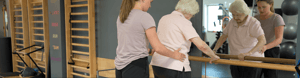
Physical therapist guides her patient holding onto a bar through a balance exercise.

FALL PREVENTION AND BALANCE PHYSICAL THERAPY | BIRMINGHAM & TUSCALOOSA, AL

Stay Balanced and Maintain Independence

Balance problems don't mean giving up the life you've built. Whether you're second-guessing every step, avoiding stairs, or falling, there's a clear path forward.

Build Confidence in Every Step

This Program is for Those Who Refuse to Accept Defeat

Balance changes aren't something you have to live with. Balance issues can show up as unsteadiness on stairs, difficulty walking on uneven ground, or a nagging fear that a fall is just one misstep away.

There is a plan forward. A personalized program that addresses your specific limitations and goals can help you rebuild the stability and confidence you're looking for.

Physical therapist guiding elderly patient through balance board training exercise at EW Motion Therapy.

Why Balance Problems Happen

Muscle Weakness & Loss of Mobility

Hip, ankle, and core strength are the foundation of stability.

When those muscles weaken from inactivity, injury, or age, your body loses the ability to correct itself when you're off-balance.

Reduced joint mobility, especially in your ankles and hips, compounds the problem by limiting your ability to adjust your center of gravity.

Coordination & Reaction Time

Balance requires your brain to process signals from your inner ear, eyes, and muscles, and respond instantly.

As that processing slows or becomes less coordinated, you lose the split-second adjustments that keep you upright.

This can happen with age, neurological changes, or simply from moving less.

Fear of Falling

Fear creates a cycle: you move more cautiously, which leads to deconditioning, which makes falls more likely.

That fear is real, and it's something we can address through controlled, progressive exposure that rebuilds confidence alongside strength.

Medical Factors & Diagnoses

Conditions that can disrupt balance:

  • Parkinson's, stroke, MS, diabetes
  • Peripheral neuropathy or inner ear disorders
  • Vision changes or cataracts
  • Medications (blood pressure drugs, sedatives, certain antidepressants) that cause dizziness or instability
Inner Ear Dysfunction

Your vestibular system sends constant signals about head position and movement.

When it's disrupted by infection, inflammation, BPPV, or age-related changes, your brain loses a critical source of balance information.

This often results in vertigo or unsteadiness.

Sensory Loss in Your Feet & Legs

Peripheral neuropathy reduces sensation in your lower extremities, making it harder to feel the ground beneath you.

When your brain has less sensory feedback, it can't make accurate balance corrections.

This becomes especially problematic on uneven surfaces or in the dark.

Not sure why you are losing your balance? We'll start with a comprehensive assessment to identify what's driving your instability, then build a plan to address it. Give us a call to discuss your specific needs.
The EW Approach: Measure, Restore, Build, RefineTM

From Unsteady to Safe:
Your Path Forward

Measure

Baseline & Assessment

Your physical therapist assesses your balance by evaluating three key systems: visual, vestibular, and somatosensory, to determine how well they work together to maintain stability.

The Goal:

Measure what matters to provide clarity and a foundation for targeted, individualized interventions.

Restore

Recovery & Movement

Treatment addresses the specific deficits limiting your balance. This may include strengthening weak muscle groups, improving joint mobility, or retraining coordination and reaction time.

The Goal:

Restore foundational strength, mobility, and proprioception to support stable, efficient movement.

Build

Strength & Resilience

Once foundational stability is in place, treatment progressively challenges your balance. You'll work through real-world scenarios like uneven surfaces, multitasking while walking, and dynamic movements.

The Goal:

Build complex movement progressions to create a more controlled and resilient body.

Refine

Movement & Confidence

Balance training is lifelong. We work with you to build a long-term plan through options such as balance classes, Pilates, personal training, and a structured home exercise program.

The Goal:

Refine your movement to improve safety, quality, and control, building the independence you deserve.

Take Your First Confident Step

Don't let balance changes create a fear of falling and a decline in activity, or cost your independence.

Real Recoveries

What Clients Are Saying

"Excellent experience at EW Motion Therapy in Liberty Park. Therapists are knowledgeable, professional, kind, and encouraging! Was referred for strength and balance because of falls. Especially like Pilates with Katherine!"
Beverley
"The Hoover EW clinic was outstanding with great professional personnel. I selected this Physical Therapy because Andrew ( therapist) worked with my wife (Margie), and I witnessed the professional attitudes on display. The therapists ( Scott, Logan, and Leah ) work with you one on one ( 1 on 1 ) to get the best session workout for your ailment."
William Cole
"6 weeks of PT for knees and improving flexibility and balance. Having had PT previously, I expected it to be repetitive and uninspiring. That is not what I found at EW. Each week I had new exercises to work on. I worked with Logan first and then Alec and both were excellent. Even though we were talking, we stayed on track and on time. If I need PT again, I am definitely coming to EW in Hoover!"
Kim Downs

Our Insurance Partners

EW Motion Therapy works with a wide variety of insurance partners to ensure you get the best care, no matter your coverage. 
  • BCBS insurance logo — insurance partner at EW Motion Therapy.
    Blue Cross
    (All plans)
  • Medicare insurance logo — insurance partner at EW Motion Therapy.
    All Medicare and Medicare Advantage Plans
  • United Healthcare insurance logo — insurance partner at EW Motion Therapy.
    United Healthcare
    (Includes all sub-plans)
  • Viva Health insurance logo — insurance partner at EW Motion Therapy.
    Viva Health / Viva Medicare
  • Aetna insurance logo — insurance partner at EW Motion Therapy.
    Aetna/ Aetna Medicare
  • Humana insurance logo — insurance partner at EW Motion Therapy.
    Humana
  • Tricare insurance logo — insurance partner at EW Motion Therapy.
    Tricare
    (All plans)
  • Cigna insurance logo — insurance partner at EW Motion Therapy.
    Cigna
    (All plans)
  • ChampVA insurance logo — insurance partner at EW Motion Therapy.
    Champ VA
  • All Worker's Compensation Plans insurance logo — insurance partner at EW Motion Therapy.
    All Workers Compensation

Start The Conversation

Tell us a bit about yourself, and we'll reach out by phone within 1 business day to match you with the right person on our team, so you can get on the path to feeling better fast.

Balance and Fall Risk Physical Therapy

Frequently Asked Questions

How long does the program take? Every person's balance challenges are different, so there's no one-size-fits-all timeline. Your program length depends on your current strength, any medical factors, and how quickly your body responds. Some patients see real improvement in 6-8 weeks; others need 12-16. But balance isn't something you "finish." Like strength or flexibility, it's a lifelong practice that keeps you steady for years to come.
Will Insurance cover this?

Most insurance plans cover physical therapy for balance and fall prevention when it's medically necessary. We accept most major insurance plans and will verify your benefits before you start. If you have questions about coverage, our team can walk you through your specific plan details.

What happens in the first evaluation? Your evaluation includes a full balance assessment, strength testing, gait analysis, and a conversation about your concerns and goals. We'll identify what's contributing to your balance issues and outline a personalized plan. You'll leave with a clear understanding of what we're going to work on and why. The evaluation takes about 60 minutes.
Is this program only for people who have already fallen? No. In fact, we'd rather see you before a fall happens. Many of our patients come in because they're noticing early warning signs like unsteadiness on stairs, needing to hold walls or counters, or avoiding certain movements. You don't need to wait for an injury to address balance concerns.
What if I've already tried Physical Therapy and it didn't help? If your previous PT experience was generic or protocol-based, you may not have received the individualized approach balance training requires. Our program is built around your specific factors: your strength, your medications, your vision, your age, and your severity. If your last PT felt like everyone was doing the same exercises, this will be different.
What happens after I finish Physical Therapy? During your final weeks of PT, your therapist will recommend the best next step based on your goals and what you need to maintain progress. Some patients transition into Clinical Pilates to continue refining core stability and coordination. Others move into personal training to build strength and conditioning. Some join our balance-focused group classes. Your therapist walks you through the options and helps you choose what fits your schedule and goals. 
I'm only in my 50's. Isn't this program for older adults? Balance changes can start in your 40s and 50s, especially if you've had injuries, surgeries, or periods of inactivity. Addressing them now, while you're still active and strong, prevents bigger problems later. This isn't about age. It's about staying ahead of decline.
Do I need a referral from my doctor? Alabama is a direct access state, so you can come see us without a physician referral. That said, some insurance plans still require one for coverage purposes, and the rules vary by plan. Give your nearest EW location a call, and we'll help you sort it out before your first visit.
Does your balance program work with kids? Yes. We work with children who are struggling with balance issues. Poor balance can lead to avoidance of physical activity, lower confidence, and coordination deficits that persist into adolescence and adulthood. Addressing it early helps kids develop the skills and confidence to stay active and engaged.