

Skip to content
Patient with Parkinson's Disease doing a punching exercise during physical therapy.

NEUROLOGICAL PHYSICAL THERAPY | BIRMINGHAM & TUSCALOOSA, AL

Your Condition Doesn't Define What's Possible

Parkinson's, MS, stroke recovery, or other neurological diagnoses all bring different challenges. Design a plan built around yours.

Outpatient Neurological Physical Therapy

We work with patients managing chronic and progressive neurological conditions in an outpatient setting. This is post-acute care for people ready to focus on maintaining mobility, reducing fall risk, and staying independent.

Conditions We Treat
Parkinson's Disease
Post-Stroke Recovery
MS (Multiple Sclerosis)
ALS (Amyotrophic Lateral Sclerosis)
Muscular Dystrophy
Post-Concussion Syndrome
Neurological Balance Disorders
Peripheral Neuropathy
Cerebral Palsy
TBI (Traumatic Brain Injury)
Important: If you're in acute recovery immediately following a stroke or TBI, you'll start with inpatient rehabilitation first, then transition to us for outpatient care.
Physical therapist guides patient through specialized exercise for neurological condition.
Trusted Partnership

Proud Partner of Parkinson's of Alabama

As a Parkinson's of Alabama partner, we provide specialized movement programs and give our patients access to support groups, educational resources, and a network of people who understand what living with Parkinson's means.

Official logo of the Parkinson's Association of Alabama, featuring black and red text and a red flower.

We Understand What You're Facing and Have a Plan.

As the patient, caretaker, or someone supporting a loved one, a neurological diagnosis brings uncertainty about what comes next, how to manage symptoms, and whether life will return to normal. In many neurological conditions, you can't control progression, but you can minimize its impact.

Our goal is full recovery when possible. When it's not, we focus on maintaining your independence and confidence, empowering your caregiving team along the way.

The EW Approach: Measure. Restore. Build. Refine.TM

From Unsure to Empowered:
Your Path Back

Measure

Baseline & Assessment

Your physical therapist evaluates strength, mobility, balance, gait, and functional deficits to identify imbalances and build your individualized plan.

The Goal:

Measure what's affecting your movement, why it's happening, and what needs to change so you can move forward with a plan instead of uncertainty.

Restore

Recovery & Movement

Rebuild foundational strength, coordination, and movement sequencing to build independence and confidence in gait, transfers, and daily activities.

The Goal:

Restore foundational control and stability so you can move through your day with greater ease, safety, and independence.

Build

Strength & Capacity

Increase capacity for functional movement by progressively challenging the strength, coordination, and endurance you've restored.

The Goal:

Build the confidence and strategies to handle the demands of your life without constantly wondering whether your body can keep up.

Refine

Movement & Confidence

Treatment shifts to long-term planning, establishing the routines and strategies you need to sustain results.

The Goal:

Refine your plan to prioritize continued progress, maximize movement efficiency, and equip you with the knowledge to manage your condition long-term.

A patient sits while rolling his foot over a ball in specialized exercises for neurological therapy.

Experience Real Progress

"After my surgeries and 9 rounds of chemo I experienced neuropathy in my hands and feet. The Therapist knew exactly what to do with releasing the stress to the nerves and taught me home exercises as well. The entire staff is always professional and caring. I recommend them to family and friends."
Allen And Kathy Holloway
The EW Difference

Treatment That Adapts to You, Not a Standard Protocol

Every neurological condition progresses differently. Your treatment reflects where you are right now and adjusts as your needs change.

Personalized Treatment Plans No two patients get the same plan. Your treatment is built around your condition stage, movement history, goals, and what you need to stay active. No cookie-cutter protocols.  
Extended One-on-One Time You're not rotating through stations or sharing your therapist's attention. Our sessions give you full one-on-one time with your physical therapist, building a relationship that makes your care more effective.  
Group Class Integration Access to symptom-specific group classes alongside your individual PT. Parkinson's classes, balance training, and movement programs that keep you engaged with others who understand what you're managing.  
Your Journey With EW

Evaluation to Long-Term Independence

Your first visit is a full evaluation. We assess movement quality, balance, strength, gait, and functional mobility. We talk about what's getting harder, what you want to keep doing, and what you're afraid of losing. That shapes your plan.

We'll build a personalized treatment plan with frequency that matches your condition severity and goals. Some patients come twice a week. Others need three times weekly initially, then taper as they build strength. Your plan is yours.

Here's what makes EW different: We don't discharge you when PT sessions end. Most clinics stop when insurance stops paying. We transition you into personal training, clinical Pilates, or condition-specific movement classes so you don't lose progress. You have a plan for every stage.


That continuum matters for neurological conditions. Consistency protects you. Our trainers and Pilates instructors understand neurological movement patterns and work with your physical therapist to keep your program progressing.


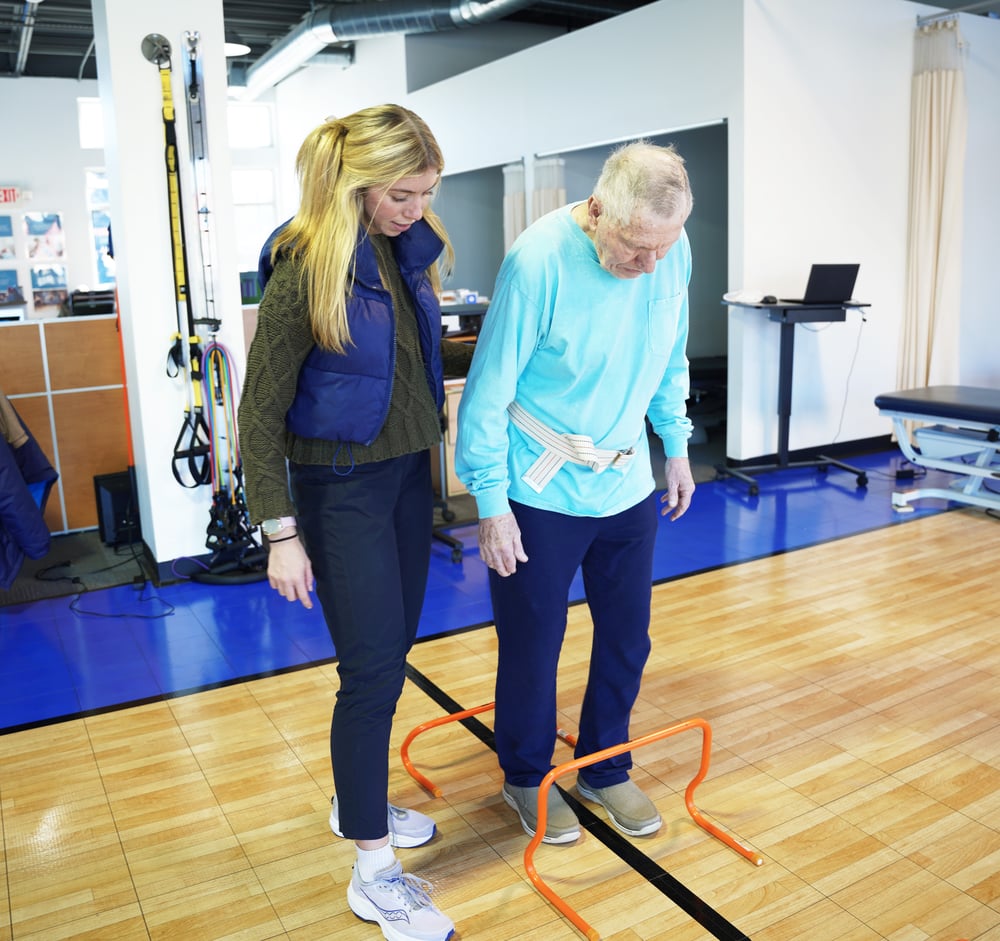
Patient with Parkinson’s disease practicing gait and balance training with a physical therapist during neurological rehabilitation.

Our Insurance Partners

EW Motion Therapy works with a wide variety of insurance partners to ensure you get the best care, no matter your coverage.
  • BCBS insurance logo — insurance partner at EW Motion Therapy.
    Blue Cross
    (All plans)
  • Medicare insurance logo — insurance partner at EW Motion Therapy.
    All Medicare and Medicare Advantage Plans
  • United Healthcare insurance logo — insurance partner at EW Motion Therapy.
    United Healthcare
    (Includes all sub-plans)
  • Viva Health insurance logo — insurance partner at EW Motion Therapy.
    Viva Health / Viva Medicare
  • Aetna insurance logo — insurance partner at EW Motion Therapy.
    Aetna/ Aetna Medicare
  • Humana insurance logo — insurance partner at EW Motion Therapy.
    Humana
  • Tricare insurance logo — insurance partner at EW Motion Therapy.
    Tricare
    (All plans)
  • Cigna insurance logo — insurance partner at EW Motion Therapy.
    Cigna
    (All plans)
  • ChampVA insurance logo — insurance partner at EW Motion Therapy.
    Champ VA
  • All Worker's Compensation Plans insurance logo — insurance partner at EW Motion Therapy.
    All Workers Compensation

Start the Conversation

Tell us a bit about yourself, and we'll reach out by phone within 1 business day to match you with the right person on our team, so you can get on the path to feeling better fast.

Neurological Physical Therapy

Frequently Asked Questions

What should I bring to my first neurological PT evaluation? Bring your insurance card, a list of current medications, any recent imaging or physician notes related to your condition, and comfortable clothing you can move in. If you use a mobility aid (cane, walker, etc.), bring it. We want to see how you move in your normal environment.
How long are neurological PT sessions? Sessions are tailored to you, typically ranging from 30 to 90+ minutes of one-on-one time with your physical therapist, depending on your tolerance and stage of recovery. You're not rotating through stations or sharing time. The full session is focused on you, your movement, and your progress.
Do I need a physician referral? Alabama is a direct access state, so you can come see us without a physician referral. That said, some insurance plans still require one for coverage purposes, and the rules vary by plan. Give your nearest EW location a call, and we'll help you sort it out before your first visit.
What happens when my PT sessions end? This is where EW is different. We don't discharge you when your insurance-covered PT ends. We transition you into personal training, clinical Pilates, or condition-specific movement classes so you can maintain your progress long-term. Many of our neurological patients continue with us for years through these programs. You don't lose momentum. You keep moving.
Can I continue with group classes after PT? Yes. We offer Parkinson's-specific movement classes and neurological balance programs at select locations. Your physical therapist will help you determine which classes match your needs and abilities. These classes give you community, structure, and accountability, and they're led by instructors who understand neurological conditions.
How often will I need to come for treatment? It depends on your condition severity, goals, and insurance coverage. Most neurological patients start with 2-3 sessions per week, then taper to 1-2 sessions as they build strength and control. Your physical therapist will recommend a frequency based on your evaluation and adjust as you progress.
Are balance classes available at all locations? Parkinson's classes and neurological balance programs are offered at select EW locations. Availability varies. Ask about class schedules at your preferred location when you schedule your evaluation.