
Your shoulder is the most mobile joint in your body, and that freedom comes at a cost. It relies on small muscles and good posture to stay stable, which is why so many people deal with stiffness, clicking, or pain as they get older, sit more, or train hard without balance. The good news is that a few targeted exercises go a long way.
Why does shoulder health matter?
Healthy shoulders depend on two things: a strong rotator cuff and well-controlled shoulder blades. The rotator cuff is a group of four small muscles that hold the ball of your upper arm centered in its shallow socket. The muscles around your shoulder blades give that socket a stable, well-positioned base.
When these muscles are weak or out of balance, the joint moves less efficiently. Common results include impingement (pinching when you lift your arm), rotator cuff irritation, stiffness and rounded-shoulder posture. Long hours at a desk, phone use and chest-heavy workouts can all tip the balance.
The exercises below work on both sides of that equation. The mobility stretches restore motion in every direction your shoulder moves, while the strength exercises build the upper back, chest, arms and shoulder blade muscles that hold the joint steady. A leg exercise is included too, because strong legs and glutes support better standing posture, and better posture means healthier shoulders.
13 Essential Exercises for
Shoulder Health
The routine has two parts: four mobility stretches that move your shoulder in every direction, followed by nine strength exercises for your upper back, chest, arms, shoulders and legs. Every exercise should be completely pain-free.
Part 1: Mobility Exercises
1. Doorknob Stretch
Improves: internal rotation (turning the arm inward).
Hold a doorknob with the hand of the shoulder you want to stretch. Slowly turn your body away from that hand, which rotates your shoulder inward. Stop as soon as you feel a light stretch, hold, then turn back.
Reps: hold 3 to 5 seconds, 10 times.
2. Wall Stretch
Improves: external rotation and reaching overhead.
Hold a broomstick or wooden dowel with an underhand grip and stand facing a wall about a foot away. Rest your elbows high on the wall. Breathe in, then as you exhale, sit your hips back slightly and let your head and chest drop down between your arms as your elbows bend. You should feel it in your upper back, underarms and triceps.
Reps: hold 3 to 5 seconds (one slow exhale), 10 times.
3. Posterior Capsule Stretch
Improves: flexibility in the back of the shoulder.
Bring one arm across your chest at shoulder height. With your other hand, hold the elbow and gently pull it across. If the front of your shoulder feels pinched, place a rolled-up towel at that shoulder as you cross over; the extra space often makes the stretch more comfortable.
Reps: hold 3 to 5 seconds, 10 times.
4. Shoulder Extension Stretch
Improves: flexibility in the chest and biceps.
Stand tall and hold a dowel low behind you with an underhand grip, hands a little wider than your shoulders. Gently pull outward on the stick as if stretching it, which switches on your upper back. Then lift your hands back and away from your body until you feel a stretch across your chest and biceps. Keep your ribs from flaring and your head from jutting forward.
Reps: hold 3 to 5 seconds, 10 times. Exhale as you lift.
Part 2: Strength Exercises
For each strength exercise, start with good posture: feet shoulder-width apart, toes forward, knees soft, ribs stacked over your pelvis, abs tight, shoulders down away from your ears, and head in line with your spine. Exhale as you lift or push, and inhale as you return. Pick a weight or band you can control for 10 to 20 reps, and do 2 to 4 sets.
5. Low Row
Strengthens: upper back and arms, and improves posture.
With a band: Anchor the band securely at chest height (never around a stair railing or anything that could slip). Pull your elbows straight back until your hands reach your ribs, squeeze your shoulder blades together for a 3-count, then return slowly.
With a dumbbell: Place one knee and the same-side hand on a bench, other foot on the floor, back flat. Let the dumbbell hang, then draw your elbow straight back toward the ceiling, hold for 3 seconds, and lower slowly. Keep the working shoulder level with the other one.
6. Chest Press
Strengthens: chest and shoulders, and builds shoulder stability.
With a band: Face away from the anchor, a handle in each hand, and press both arms straight out. Only bring your elbows back as far as feels comfortable; at first, that may be just in line with your body.
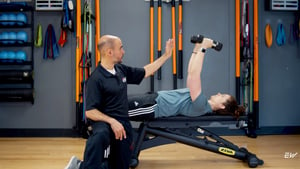
With dumbbells: Lie on a bench or the floor with elbows at about 45 degrees from your sides. Press the weights straight up over your shoulders, then lower only as far as is pain-free.
Elevated push-up: Place your hands on a countertop or sturdy chair and walk your feet back so your body forms a straight line. Lower your chest slowly, pause, and press back up. Go only as deep as your shoulders allow.
7. Hammer Curl
Strengthens: biceps.
Hold dumbbells (or a band anchored under the middle of one foot) with your palms facing each other. Bend your elbows to bring your hands to your shoulders, squeeze, then lower slowly. With a band, keep your whole foot planted so it can't slip out.
8. Triceps Press
Strengthens: the backs of the arms, and supports shoulder stability.
Lie on a bench or the floor holding dumbbells straight above your shoulders. Keeping your upper arms still, bend your elbows to about 90 degrees so the weights move back toward your head, then straighten your arms and squeeze your triceps.
9. Reverse Fly
Strengthens: the back of the shoulders and upper back, and improves posture.
With a band: Hold the band straight out at shoulder height with whichever grip feels best. Keeping your arms straight, pull it apart until it touches your chest and your body forms a T, then return slowly.
With a dumbbell: In the same bench position as the dumbbell row, let a light dumbbell (about 5 pounds is plenty) hang under your shoulder. Raise your arm straight out to the side until it's level with your body, no higher, then lower slowly.
10. Scapular Activation with Weight Shifting
Trains: your shoulder blades to move properly, plus shoulder and core stability.
Get on all fours with knees under hips and hands under shoulders, head in line with your spine. Let your chest sink as your shoulder blades squeeze together, then push the floor away so they spread apart. The movement comes only from your shoulder blades. After 10 to 20 reps, hold a strong position and reach one arm forward, then the other, without sinking into the supporting shoulder.
11. Lat Pullover
Strengthens and lengthens: the latissimus dorsi, the large muscles of your back.
Lie on a bench or the floor holding a medicine ball or dumbbell with straight arms above your shoulders. Breathe in as you lower it back overhead into a comfortable stretch, then exhale as you bring it back over your shoulders. Keep your ribs down so your back doesn't arch.
12. Overhead Press Progression
Builds: overhead mobility and strength, which tend to decline with age.
Overhead work can feel intimidating with a history of shoulder pain, so build up in stages. Move to the next stage only when the current one is completely pain-free.
- Wall slide with a towel: Stand facing a wall with your hands on a towel. Exhale as you slide your hands up the wall without arching your back, then lower.
- Band overhead reach: Hold a band shoulder-width apart, pull it slightly apart, and raise your arms overhead thumbs-first until your biceps are by your ears.
- Dowel press: Hold a dowel at shoulder height with an overhand grip. Pull outward on it as you press it overhead, then squeeze inward on it as you lower it.
- Single-arm dumbbell press: Start with a dumbbell at your shoulder, elbow about 45 degrees out in front. Press it overhead, then lower slowly. Working one arm at a time lets your rib cage move naturally.
13. Goblet Squat
Strengthens: legs and glutes, which support better standing posture and, in turn, healthier shoulders.
Hold a dumbbell vertically against your breastbone, just under your chin. Stand with feet shoulder-width apart and toes turned out slightly. Push your hips back toward a chair behind you, keeping your chest tall and weight in your heels, tap the chair, and stand back up. If your heels lift, place a rolled towel under them. Stop if you feel any knee or low back pain.
How to Put the Routine Together:
Do the four mobility stretches first; they warm up the shoulder and can also be done on their own most days. Then do the strength exercises two to three times a week on non-consecutive days.
|
Part |
Exercises |
Sets and Reps |
Frequency |
|---|---|---|---|
|
Mobility |
1 to 4 |
10 reps, holding each 3 to 5 seconds |
Daily or before strength work |
|
Strength |
5 to 13 |
2 to 4 sets of 10 to 20 reps |
2 to 3 times a week |
If you're new to exercise, start with 2 sets and one version of each exercise, such as the band version. A full session takes roughly 30 to 45 minutes. When the last few reps feel easy, move to a heavier band or dumbbell.
Safety Tips and When to See a Professional
These exercises are meant to feel like work, not pain. Mild muscle fatigue or a gentle stretch is normal; sharp, pinching or lingering pain is not.
- Start light. Choose a band or weight you can control for every rep. For moves like the reverse fly, about 5 pounds is plenty.
- Move slowly. Control both the lift and the return, and avoid shrugging your shoulders toward your ears.
- Stay in a pain-free range. Only lift, press or stretch as far as you can without pain. Some muscle effort is normal; joint pain is not.
- Be consistent. Results come from steady practice over several weeks, not from one hard session.
- Anchor bands securely. Use a sturdy anchor the band can't slip off, never a stair railing, and keep your foot fully planted on bands you stand on.
Talk to a doctor or physical therapist before starting if you have a recent injury, surgery, or a diagnosed shoulder condition. Get checked promptly if you notice pain at night, weakness lifting your arm, numbness or tingling, a loss of motion, or pain that lasts more than a couple of weeks. This article is for general education and isn't a substitute for personalized medical advice.
Frequently Asked Questions
How often should I do shoulder exercises?
Two to three times a week is enough for most people. Gentle stretches like the doorway and cross-body stretch can be done daily.
What are the best stretches for shoulder mobility?
A good stretching routine covers every direction the shoulder moves. The doorknob stretch improves inward rotation, the wall stretch improves outward rotation and overhead reach, the posterior capsule stretch loosens the back of the shoulder, and the shoulder extension stretch opens the chest.
Can I do shoulder exercises at home?
Yes. Every exercise in this routine can be done at home. You'll need a resistance band, a pair of light dumbbells, a broomstick or wooden dowel, and a sturdy chair or bench. Most strength exercises have a band or dumbbell option, so you can start with whichever you have.
How long does it take to improve shoulder strength?
Many people notice better posture and less stiffness within a few weeks. Meaningful strength gains usually take 6 to 8 weeks of consistent training.
Should I exercise if my shoulder hurts?
Mild soreness after exercise is normal. If an exercise causes sharp pain, or if pain persists, stop and see a doctor or physical therapist before continuing.